
Your UPI ID, and the two other ways to be paid
Most of what people search for under «UPI ID» turns out to be about one app rather than about UPI. The addressing itself is smaller than it looks, and it is written down.
18+ only. This site is not NPCI, not a bank and not a casino.
An address, not an account
A UPI ID points at a bank account. It is not the account, and losing it does not lose the money.

NPCI describes the system itself in one line: Unified Payments Interface is «an instant payment system developed by the National Payments Corporation of India (NPCI), an RBI regulated entity». Payment addresses are the part of it a person actually handles. When you pay a shop online, their own wording is equally plain: you «will need to enter your Payment Address (eg - xyz@upi)».
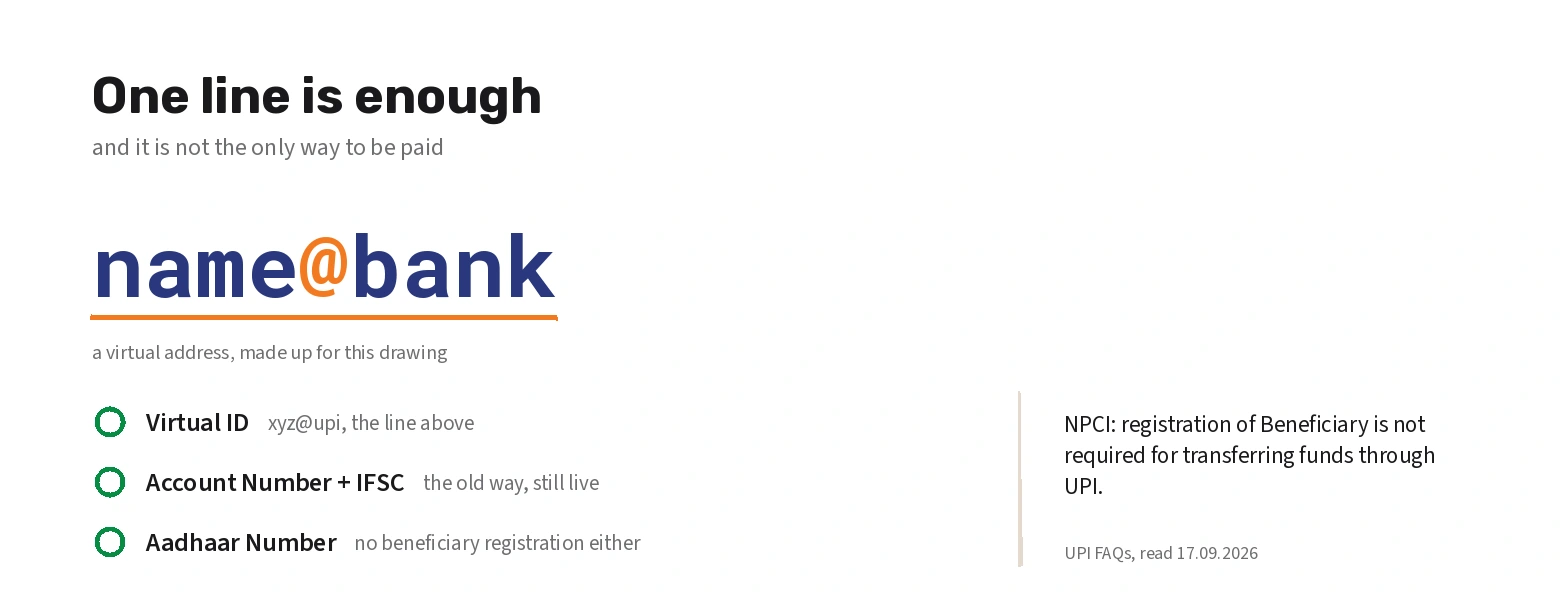
Three ways in, and none of them needs paperwork first
The thing people expect from bank transfers — adding a payee and waiting — is simply absent here.
- The virtual address
The line that looks like a mail address. It is tied to the provider you registered with, which is why it changes when the provider does.
- Account number with IFSC
The older pair still works inside UPI. Whoever is receiving does not have to be registered for UPI at all when this route is used.
- Aadhaar number
Listed by NPCI alongside the other two as a channel for transferring funds. Same rule about the receiver not needing to be registered.
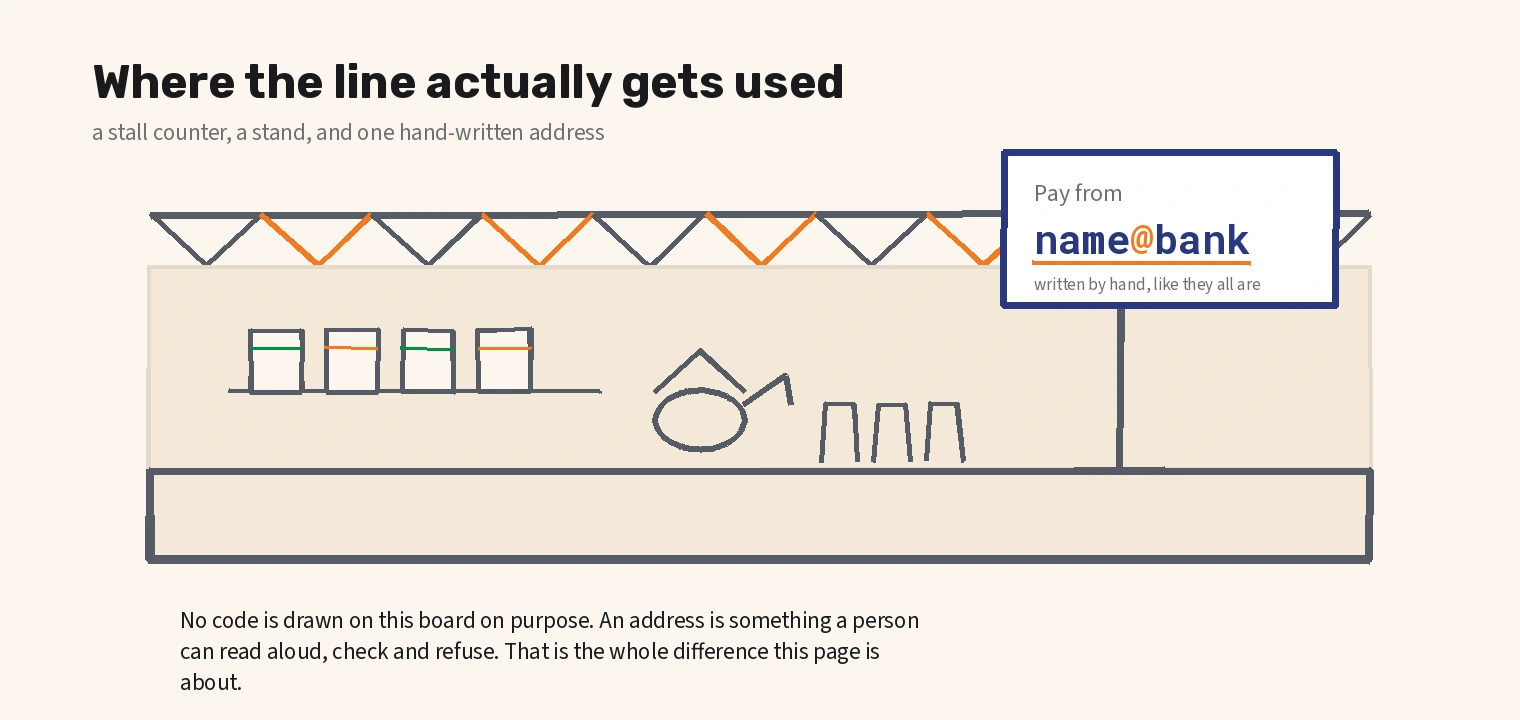
«No, registration of Beneficiary is not required for transferring funds through UPI as the fund would be transferred on the basis of Virtual ID/Account+IFSC/Aadhaar Number.»
UPI FAQs, NPCI · read 17 September 2026The same page adds the part that catches people out in the other direction: several bank accounts can sit behind one address, «depending on the functionalities being made available by the respective PSPs». Which of them a given payment leaves is a choice made inside the app, not a property of the address.
Nothing is taken off the top
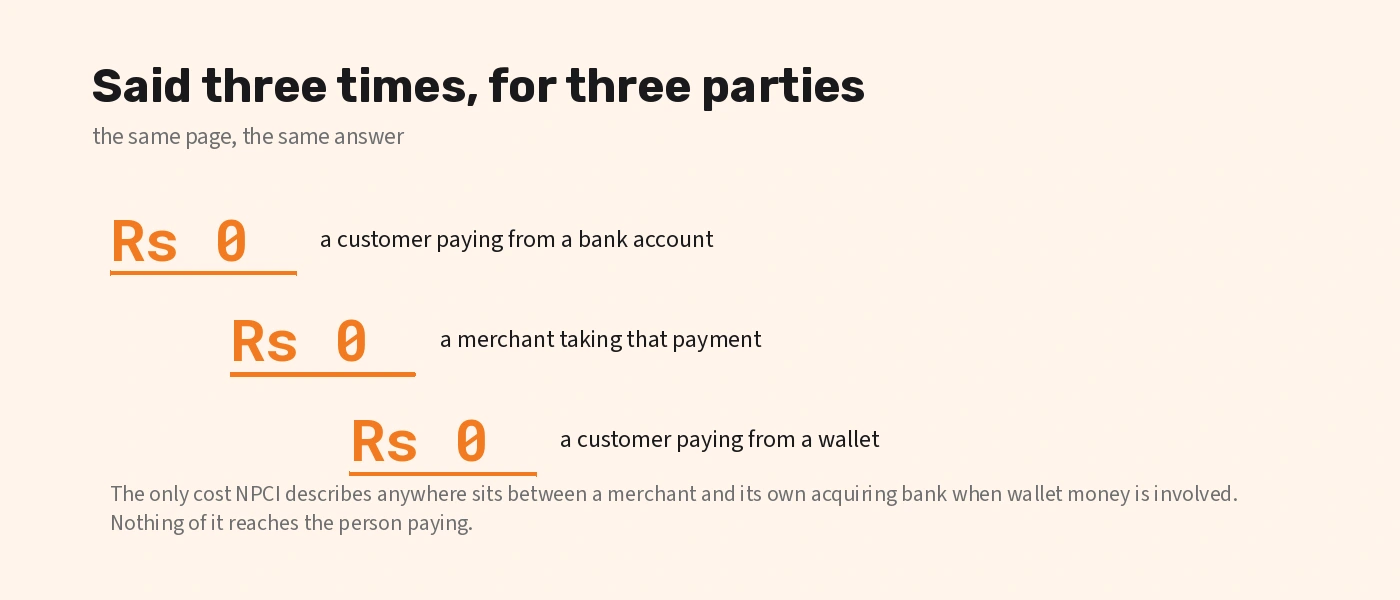
This is stated three separate times in the same NPCI page, for three separate parties.
Rs 0
«There are no charges to be paid by the customer using bank account to make your UPI payments.»
Rs 0
«If you are a merchant and accepting UPI payments from the customer’s bank account, then there are no charges applicable.»
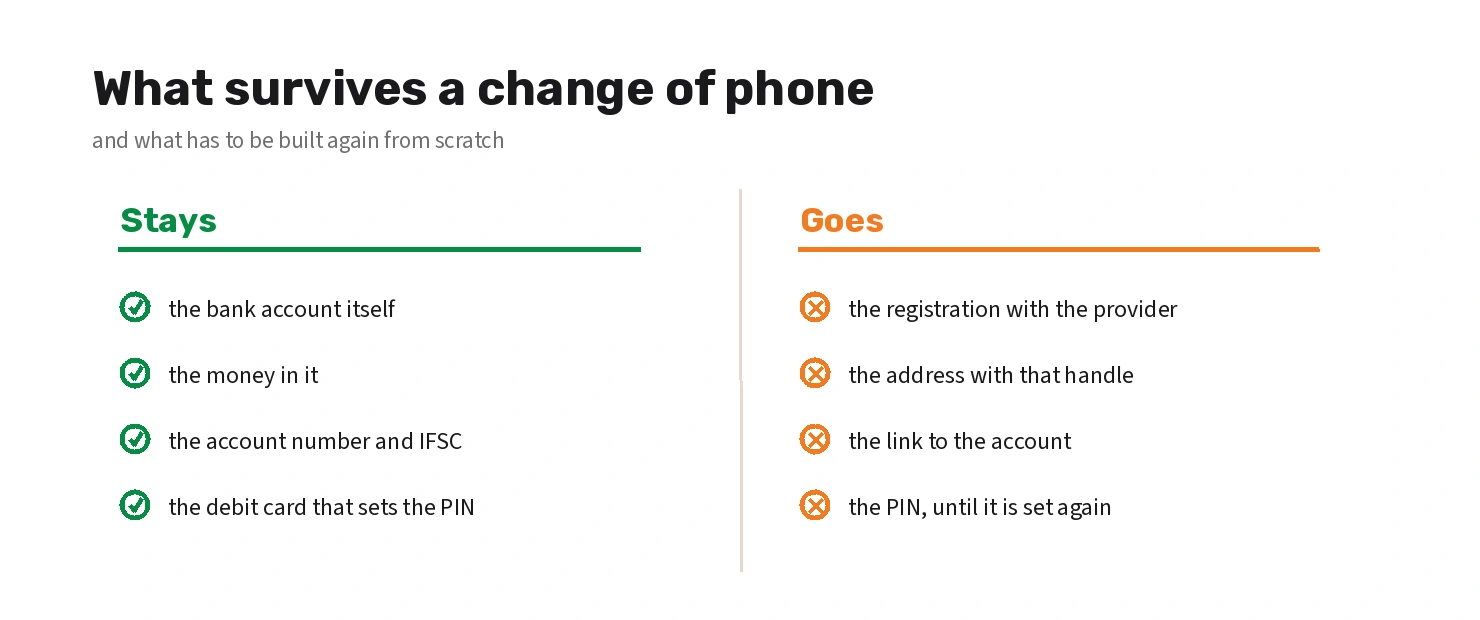
Change the app and the line changes with it
The handle after the separator belongs to the provider. Move, and it cannot follow you.
NPCI puts it without softening: «In case of change in UPI App, a person needs to re-register and it needs to create a new VPA with the handle of the PSP.» The same applies more widely — a new SIM, a new handset or a new provider app all mean registering again. Anyone who has printed an address on an invoice, a signboard or a profile is the one who feels this.
What that means before you hand the line to anyone
Treat it as something that can expire rather than as something permanent. Losing the phone is the milder case: the account is untouched, because authorising anything still needs the PIN, which is not stored in the handset for anyone to find.
Four things worth a glance before a deposit
None of these are about UPI being risky. They are about the two or three details a payment page will not repeat for you.
-
01
Which bank account is linked right now
One address can sit on several accounts. The app shows which one is selected, and that is the account the money leaves.
-
02
That you are the one entering the PIN
Nobody needs your UPI PIN to send you money. A request to type it in order to receive something is the request itself going wrong.
-
03
The bank message, not only the app screen
A success screen inside an app is a screen. The debit is what your bank tells you, and that is what a dispute is argued from.
-
04
That the account is in your own name
Almost every operator requires the payment instrument and the gaming account to belong to the same person before a withdrawal.
The links in this section are sponsored. No operator is named here because cashier rules change without notice: the list that counts is the one inside the casino itself.
Asked most often about the address itself
What exactly is a UPI ID?
An address that points at a bank account, in the shape name@handle. NPCI shows it as xyz@upi when describing an online payment. It is not the account itself and it is not a wallet with money sitting in it.
Do I have to add someone as a payee before sending money?
No. NPCI states it directly: registration of a beneficiary is not required, because funds move on the basis of a Virtual ID, an account number with IFSC, or an Aadhaar number.
Can one address sit on more than one bank account?
Yes. Several bank accounts can be linked to the same virtual address, depending on what the provider you registered with makes available. Which account a payment leaves is chosen in the app.
Does the person receiving money need to be registered for UPI?
Only for the virtual address route. When the payment is addressed by account number with IFSC or by Aadhaar number, the receiver does not have to be registered.
What happens to my address if I switch to a different app?
It does not travel. Changing the app means registering again and getting a new address carrying the new provider’s handle. The same is true after a SIM change or a new handset.
Is there a charge for paying this way?
Not from a bank account, on either side. NPCI says there are no charges for the customer paying from a bank account, and none for a merchant accepting that payment.
Can I use two UPI apps on the same phone?
Yes, and they can be linked to the same accounts or to different ones. NPCI answers that question with a plain yes.
Does UPI stop working outside banking hours?
No. Their wording is that all payments are instant and available 24/7 regardless of your bank’s working hours.